When Henry Jocelyn reviewed Edward Courtney’s Fragmentary Latin Poets (1993) in Hermathena (1995), a major vector of complaint was Jocelyn’s perception of the capriciousness of Courtney’s selections of material in the face of a theoretical “totality.” Jocelyn begins (p53):
“The title of this book and the advertisement on the dust-jacket appear to claim that all the surviving bits of the Latin poems produced between 743 B.C. and A.D. 476 and not transmitted to ourselves entire can be found between its covers.”
A brief history of the various attempts to make editions of “fragmentary Latin poets” follows, including: Antonio Agustín (whose 16th c. collection “remained in manuscript”), Robert Estienne printed by Henri Estienne (1564); Emil Baehrens (1886), subsequently iterated by Willy Morel (1927), Karl Büchner (1982), and, soon after this review, Jürgen Blänsdorf (1995). Amidst this unfolding genealogical documentation of omissions, excisions, and expansions, Jocelyn (p53) first critiques the failed totality of Emil Baehrens’ Fragmenta Poetarum Romanorum:
“This ought to have included everything cited by surviving ancient writers from poetic works which did not survive, but Baehrens behaved somewhat wilfully.”
The critique of Baehrens’ “willfulness” prepares the way for Jocelyn’s (p54) critique of Courtney’s “personal whimsy”:
“Edward Courtney keeps the inner structure of Baehrens’ FPR but toys with the superstructure more than Morel or Buechner did. Various slips (e.g. the reference to ‘DServ.’ and ‘codd.’ in relation to Cinna, fr. 6 on p. 218; the implication of a sentence on p. 251 that the ‘codex Illyricus’ of Festus was something other than cod. Naples, Bibl. Naz. IV. A. 3) indicate a less than total grasp of the sources of the material. No clear general design emerges from the preface or from the ‘fragments’ actually included in the volume. Personal whimsy runs free.”
Of course, the idea that an authoritative scholar (or anyone, for that matter) might zero in on our “mistakes” and thereby accuse us of not knowing what we’re doing is itself deeply chilling – and in this case evidences the rootedness of our scholarly practices in a culture of honor and shame (especially shame), while also showing the human side of scholarship (even the big names make “mistakes”!). It would be fruitful here to consider Tema Okun’s identification of perfectionism as a characteristic of white supremacy culture: “mistakes are seen as personal, i.e. they reflect badly on the person making them as opposed to being seen for what they are – mistakes”; “ making a mistake is confused with being a mistake, doing wrong with being wrong.”The truth is that the outgrowth (iterating, versioning, re-versioning) of these fragmentary editions is ultimately motivated by the sense that our scholarly precursors were not quite correct in their editorial selections or the overall execution of the project.
But let’s think about what it means to get this “right.” Jocelyn’s initial statement that a book called Fragmentary Latin Poets ought to contain every “bit” of “not-entire” Latin poetry from the founding of Rome to the fall of (the western half of) empire indicates an underlying desire for fragmentary editions to capture an impossible totality. And when Jocelyn found mistakes in Courtney’s work, he saw this as evidence of a “less than total grasp” of material so massive that it essentially represents a disciplinary totality. Now, Courtney himself engaged in this kind of critique of fragmentary editions, for instance in his BICS (1984) review of Morel and Büchner (p131):
“Now a revision of the work by Karl Büchner (Teubner, Leipzig 1982), has posthumously appeared, which has corrected a good few of Morel’s errors and supplemented a number of gaps. But Büchner is no more impeccable than Morel; there are still gaps and errors in what he provides.”
Courtney, then, was also engaging in some theorization of totality in addressing “gaps and errors” (via the moralizing language of scholarly “sin”). But when Courtney (p72) replied to Jocelyn’s review in Hermathena (1996), he responded to critique by pointing out the ways in which Jocelyn’s own knowledge (or, performance of knowledge) was less than “total”:
“‘The title of this book…appear(s) to claim that all the surviving bits of the Latin poems produced between 753 BC and AD 476 and not transmitted to ourselves entire can be found within its covers.’ Consider now the title of Jocelyn’s only book (I shall return to that word ‘only’ at the end), The Tragedies of Ennius, the Fragments (edited with an Introduction and Commentary). We then find with astonishment that the last 100 lines of fragmentary text are left without annotation.”
Aside from the fact that the heightened and competitive severity of tone in these discourses of review might dissuade some from entering into such “debates” at all – and thereby produce the kinds of “shadow books” theorized by Kevin Young (2012): i.e. the books that “fail” to be written – I find it significant that the question of the fragment is so wrapped up in the concept of totality. Aside from the fact that “totality” is essentially beyond human comprehension, the “fragment” describes so many different kinds of “non-entire” cultural artefact that no collection, no Borgesian “library” will ever rematerialize the totalities we have imagined. At the same time, the perception that these editions are lacking in some way (the “lack” is baked in – no amount of scholarly annotation will remedy it, although that isn’t a reason not to annotate) means that we will probably never stop iterating these editions.
The more we attempt to approach totality, the more we inscribe ourselves into the fragments. (For it is no longer a “fragment” of whatever Latin poet or poem: but Jocelyn’s or Courtney’s – right?). Indeed, that was partially Jocelyn’s point: that Baehrens’ “willfulness” showed too much of his own personality, too much of his own “will” (as opposed to some theoretically “objective” selection process); that Courtney showed too much “personal whimsy.” The concept of totality presupposed is supposedly antithetical to the personal choice of an editor – but these choices will always be “personal” to some extent, and pretending otherwise is dishonest. (Modern selectiveness meets ancient selectiveness, though: perhaps the topic for another blog post is the fact that what is fragmentary is what has undergone, in many cases, the “personal whimsy” of ancient commentators.) More can be said about what a fragmentary edition intends to convey, and about what such a work presupposes about the possibility of “collection.” If totality is the intention, though, then the fragmentary edition is – in my view, anyway – committed to a conceptual impossibility.
“Each member of the family in his own cell of consciousness, each making his own patchwork quilt of reality – collecting fragments of experience here, pieces of information there. From the tiny impressions gleaned from one another, they created a sense of belonging and tried to make do with the way they found each other.”
Toni Morrison (1970/2007), The Bluest Eye, p34.
One of the challenges of working on fragments, and one of the rewards, is the pervasiveness of the concept. Although admittedly I know I am particularly sensitive to the word, and always on the lookout for it – indeed, always searching for scholarship, always seeking editions, and always feverishly taking down notes in my own journals on whatever fragments I find – the term “fragment” seems to appear in everything I read, no matter what it is. As I move outside and around the concept of “classical” fragmentation, which has certain particular and technical definitions (relating to material disintegration as well as textual integration – and a tense interrelationship between the filtering of the “mainstream” and “non-orthodox”), the idea of the fragment appears consistently within discourses of alienation, marginalization, and loneliness. Since the fragment (from Latin frangere – “to break”) presupposes an act of violence (from our historical vantage often invisible violence: we don’t always know how or why something “breaks,” “breaks down,” or “is broken” – although sometimes we do), we use this word of a variety of personal experiences relating to mental environments: memories, emotions, but also internal perception of external realities.
I am trying to bridge the gap between the ceremony and monumentalizing of ancient thought via fragmentary excerpts, and the broader metaphor of fragmentation which seems to represent so much of human experience. In the passage from Toni Morrison’s The Bluest Eye quoted above, we find a horizontal model of fragmentation which is different from the verticality of some ancient fragmentary processes (which are: quotations of quotations of quotations – Seneca (Ep. 108.34) quoting Cicero quoting Ennius, for instance). Morrison’s use of “fragment” here relates to partiality: an understanding that there is a totality of experience within each individual which simultaneously indicates the difficulty of conveying that totality – and instead of meeting “eye-to-eye” (as it were – and, indeed, the “bluest eye” represents a gaze that cannot be met), we might meet, instead, at small (and fleeting) moments of convergence. But in that meeting, there is a mutual holding: “they created a sense of belonging and tried to make do with the way they found each other.” And mutuality is fundamental to fragmentary processes: even though the fragment is often packaged as an atomized, isolated phenomenon (buttressed by rhetorics of “loss”), pieces of things come into our hands because they have been held onto: they have not traveled alone (and here we might positively cite: Ennius/Cicero/Seneca). Morrison’s conceptualization of partiality here is actually surprisingly optimistic: partiality is not simply the limits of disclosure (beyond which we “lose” something), but the meeting point. In other words, the fragment is not simply a broken thing, but a node of interconnection.
* * *
I haven’t blogged in a long time. And in the interim, some things have changed for me. My book came out. I moved to a new institution. I was tenured. After five years in Boston, I’m back in Los Angeles – where I lived as a graduate student and where I still have deep roots. Inevitably, I find myself meditating upon that time, which in some ways seems so distant (given the massive upheavals which have taken place in the interim: elections, pandemics, disciplinary ruptures) but is now – as I revisit old haunts – also so present. Moments of major change hold within them the opportunity of self-reflection: to shed old habits, and to seek greater self-alignment. When I was a graduate student, I blogged casually and didn’t overthink anything. That’s when I first started to find community on twitter, too. (Although I have a much longer personal relationship with writing and the internet – reaching back to the online forum culture of the mid 2000s.) In major ways, our online communities have changed since I’ve been a part of them – in some ways expanded, but in many ways contracted. Some of our colleagues have kept a consistent blogging practice (and I am particularly inspired by Josh Nudell). But blogging has always been a complicated thing in the context of academic currency, as we are pressured to funnel our intellectual labor into the few sacralized spaces which theoretically increase or safeguard our scholarly authority. At this point in my career, however, I want to think carefully and deeply about where and how I use my own voice. Part of this relates to how I plan my next research projects (how to study the questions and texts which I remain drawn to), and part of this relates to how I convey my thoughts to different kinds of audiences. In sum (with the hopefulness that an intermittent blogger brings to each sporadic blog post), I hope to bring new life to this space – and to rekindle a casual writing practice relating to my scholarly work.
“being an expert on fragments is like being an expert on nothing” 😉
In many ways, I’m not a digital humanist. I don’t know how to code. I’ve never built a database. I don’t work with “data”. My research would be quite challenging to communicate visually (with charts, infographics) in a way that would be satisfying. I have a basic literacy in html which is pretty much obsolete now. A lot has been written about the fact that “digital humanities” is difficult to define, exactly. When I was at Patrick Burns’ Ancient MakerSpaces digital classics workshop at the 2017 SCS — which showcased tools for creating and managing digital information within the field of Classics — it occurred to me that I had a different background than the majority of the other audience members. Many of the individuals in the audience had a similar level of technological literacy to the speakers — they could understand the presentations from a technical perspective in a way that I simply couldn’t. But I think it’s important for people like me — perhaps more “humanist” than “digital” — to be present in such spaces. These are the ways in which I do consider myself a digital humanist: I am present in a scholarly persona online, and I believe that scholars should be engaged in the project of the internet. I’m a digital humanist in the sense that I want to tell the stories of the humanities online, using its tools to reach a larger audience, and to increase the reach of learned networks beyond its traditional limits. And I see the benefits of bringing the forms of the internet, which encourage discussion, into the classroom (with blogging etc.).And someone like me can perhaps help make bridges between the digital and non-digital humanists. Even if you yourself as a scholar are not engaged in a particular aspect or practice developing within your field — such as digital humanities — you’re still influenced by these developments. Weller (2011: loc 2612) calls this “network weather”, i.e. “changes in your environment are occurring because of other people’s use of these technologies and the behaviour they facilitate, even if as an individual you are not engaged with them.”The digital humanities — which gives us online editions and commentaries of texts, databases of papyri, digital books, thousands of high quality images of ancient objects facilitated by creative commons license, and more — are already pretty incredible, and are only going to get better and better, provided they find continued support, financial and otherwise. It’s up to us to shine a light on these projects and tools, and to make sure our students — especially the graduate students who will shape the next generation of Classics — are given the opportunities to learn and use these tools.
We’ve been speaking a lot about Classics outreach lately. And most agree that “outreach” – in the sense of a one-sided “reaching out” – is not quite the right term anymore. Alison Innes (@InnesAlison) recently argued for the term “engagement” rather than “outreach”, since engagement suggests a notion of exchange rather than the flow of knowledge in only one direction. The preference for engagement over outreach has been visible for a while — this was the takeaway from the “New Outreach and Communications for Classics” panel at the 2017 SCS, where speakers described community projects: teaching Latin to kindergarteners, high schoolers; working through Homer with combat veterans; connecting classicists outside of academia. The notion of outreach as engagement and collaboration is also at the core of the new Classics and Social Justice group, which wants to bring Classics to the least privileged in society. There have been some questions lately about whether or not twitter can be a useful tool for Classics engagement — in this debate, I stand firmly on the side that sees the value in twitter. There is much more to “outreach” than can be accomplished by social media alone, but it’s still a valuable place to start.
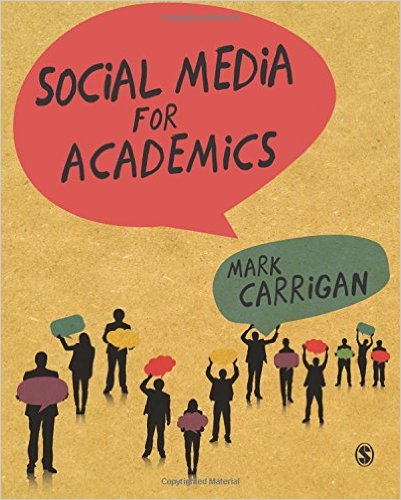
I use twitter in my scholarly persona — I tweet about my research, I live tweet conferences, I interact with other academics and non-academics interested in Classics, I find news about my discipline on twitter. If I were teaching right now (I have a research fellowship), I would be using it in the classroom. But I wanted to learn more about academic twitter from a scholarly perspective – to learn how it’s studied as a social phenomenon by academics. For this, I turned to sociologist Mark Carrigan’s (@mark_carrigan) book which came out last year, Social Media for Academics.
Mark Carrigan, Social Media for Academics. Sage; Los Angeles. 2016. ISBN: 9781446298688
Although Carrigan’s book contains many helpful tips for academic blogging and tweeting, it’s not primarily a how-to guide but rather a sociological exploration of the state of academic tweeting as it exists today. As Carrigan writes (loc 166)¹, social media develop so quickly that by the time a scholarly work is finally published, the information it contains is already outdated. The first chapter begins by describing the almost unimaginable volume of information which is published on the internet every day, citing the Internet Live Stats project. If you click on this link, you can have the frankly nauseating experience of seeing how many blogs, tweets, emails, skype calls, tumblr posts are being made/sent in real time. But it’s a powerful way to show the vastness of the internet, its modes, and its growth. Sometimes social media are maligned as essentially superficial — but something more complicated, with greater consequences, is going on. Social media touch our personal lives, our political lives, and the state of our knowledge. Recently, I tweeted about how the current POTUS’ use of twitter will force future historians to come to terms with the nature of social media and its impact on society and knowledge — a compelling reason why scholars should now be involved in the project of the internet.
One of the best things that I got out of this book is that the notion of “scholarship” doesn’t have to be defined by the memory of past models, but by the actions which we now take. Carrigan — citing Weller (2011: loc 105)— writes that “scholarship is what scholars do.” The tautology of this definition is actually helpful – it can free us from saying “this action isn’t scholarly”, and allow us to say “well this scholar is doing this, therefore by definition it is included in the remit of what scholarship is.” Being freer about the definition of what is or isn’t scholarly can allow scholars to embrace parts of themselves that they feel they have to hide to live up to the image of academia. I’ve written elsewhere about how it’s no coincidence that those who are attracted to scholarly twitter are those from groups typically underrepresented by the “professor” archetype (PoC, women, LGBTQ+) — twitter is a new(er) space where the performative associations of the “professor” don’t have to be enforced. In fact, Carrigan notes that, if you are an established or even famous scholar, you can’t assume that that is enough to attract followers or to foster a positive reception of your social media presence (loc 2239). This is because social media is about prolonged, consistent engagement. It’s about what you’re saying in the moment, and it’s as much about listening as it is about broadcasting.
What becomes clear over the course of Carrigan’s book is that the main activities of scholarship — writing, publishing, networking, engaging — are all involved (and, arguably, enhanced) when scholars use social media. The only difference is that, when we use social media, the actions that are essential to the life of the scholar are taken in public.
For Carrigan (citing dana boyd 2014), social media have specific and significant qualities which bring scholarship into the public eye — persistence, visibility, spreadability, searchability:
persistence: once ideas are posted they (theoretically) last forever— “the experience of twitter is similar to that of being at an academic conference, but a conference in which our conversations linger on indefinitely in the room” (Carrigan loc 276); in this sense, social media is a form of record keeping
visibility: ideas once posted can be seen by many people — with a platform like twitter, you don’t even have to have an account to see what’s happening on it; using social media brings your scholarly work into the view of the public, to whom you may otherwise be invisible — and it can also make your work more visible to other scholars
spreadability: ideas once posted are easily circulated — sharing or retweeting brings information into the sight of your friends or followers, who can then pass it on to their friends or followers
searchability: ideas once posted can be found with search terms— and since they are persistent and visible, i.e. are lasting and accessible to everyone, ideas can be found even if they haven’t been widely circulated
Carrigan is sensitive to the issue that “public” is a complicated idea; he opts instead to call the online audience “publics” (loc 1174). When scholars use social media to publicize their own work, and also — by extension — the kind of work done by their discipline, who are they talking to? Although Carrigan mentions the usefulness of social media in teaching students, this is not his main focus — he redirects his reader to Megan Poore’s guide, Using Social Media in the Classroom(2016). Instead, the interactions which he seems to focus on are between scholars and other scholars; between scholars and non-scholars. It isn’t exactly the case, Carrigan says, that when we use social media we are really trying to talk to “everyone” (loc 1149) — instead, we’re engaging in a kind of narrowcasting, defined by Poe (2012) as “the transmission of specific information to specific interest groups.” Narrowcasting may seem to support the view that twitter is an echo chamber, but Carrigan argues that the scale of the dissemination of information via the internet is much larger than anything we’ve known before (loc 1159):
This is a potentially transformative environment for academic research because it means that intense specialisation need not lead to cultural marginality. Even the most seemingly obscure topics have a potential audience outside the academy.
There is an assumption that because academic interests can be very specific, there isn’t an audience for that level of fine grained detail. Well, that’s not the case. Talking about a topic to people who are interested is powerful — it may not be that many people in the grand scheme of things, but it’s still many more than would have access to you, if that access was predicated on entry into a university environment.
And when academics use social media — even in a “professional” persona — we’re bound to include elements of our lives beyond just our work. Carrigan suggests that this can create a “new collegiality” between scholars (loc 894), because it draws attention to the obstacles faced by individuals which otherwise might not be spoken about. From personal experience, I find this to be true — I think of Ellie Mackin’s (@EllieMackin) open discussion of the challenges facing early career academics and the challenges of maintaining mental health in academia, which have found vigorous support in the online community.
Carrigan also points out the potential for social media to present a fuller picture of a scholar when “all manner of ephemera…get aggregated together into a stream, mean[ing] you sometimes get better acquainted with someone through a process that is almost osmotic” (loc 936). The aggregate view of the scholar is something that I love about twitter. At some point or another, you may read my CV, or some personal statement, or a research proposal. And certainly, we have to work hard rhetorically in such documents to make ourselves understood, to seem vibrant, to demonstrate our value. But you’ll really get to know me as a scholar if you follow me on twitter; you’ll get a sense, after the accumulation of hundreds of pieces of tiny information, of who I am – what my values are, how I do my research, how I interact with my community. You’ll also get a sense of who I am as a human person.
Blogging is also a large preoccupation of Carrigan’s book. One of the issues with scholarly blogging, which doesn’t seem to be explicitly stated by Carrigan but is definitely on my mind a lot, is the fact that we as scholars work hard to produce research that we can’t really give away for free. Our success depends on publication in traditional media — we get promoted because we write articles and books. One model suggested by Carrigan which gets around this problem, is that scholars can “blog about the work, but not blog the work” (loc 735). Academics can write about the process of writing, as well as sharing resources which have been encountered during the research. Carrigan brings up the issue of speaking to multiple audiences simultaneously, and how various prominent bloggers deal with this. He cites Paul Krugman, Nobel prize winning economist who blogs for the NY times, who labels the more technical posts as ‘wonkish’ in the title to signal potential difficulty for mass readership. And then, there’s our Mary Beard, who writes short blogs for the TLS every few days. Both of these figures are world class academics who are secure in their renown and reputation; and they have the confidence to be able to write short pieces frequently. They also have the confidence to be contemplative rather than positivistic — they can say “I’m thinking about this right now” rather than “this is definitively the case”. But that confidence comes from being established. Sensible equivocation in them may read as uncertainty and luke-warmedness in individuals of lesser status. But I do think that the model of writing short blog posts reasonably frequently is a good one — one that I’m thinking of using in the future myself.
Carrigan also draws attention to the usefulness of social media as research tools. This is definitely something that I’ve found to be true — twitter, for example, can have an archival function:
@opietasanimi Not to mention a placeholder for future leads that I don't have time for at the moment.
I frequently use tweetdeck to search for tweets I’ve made in the past about certain elements of my work. Blogging can have this function as well — working out some thoughts about a minor point and posting it online can serve as a organic growth of work, linked thematically rather than in a linear way — “the result is a ‘body of knowledge’ that is ‘more threaded and less sequential’ ” (loc 1558). Carrigan invokes Stuart Elden, writer of the Progressive Geographies blog, and his view that a blog is a “public notebook” or a “public set of bookmarks” (loc 1564). Live tweeting conferences also feels a bit like making notes in public.
In such a world where information is gathered (or aggregated) online, distraction is an issue. Anti social media screeds written by academics often begin from this point — that social media are a distraction. From what? Supposedly from the serious thinking and writing that happens when everything else is shut off. But for Carrigan, distraction is recoded as a positive thing, in the sense that, reading through the information that twitter and other outlets provide you ‘supersaturates’ (Gitlin 2002) the scholar with many relevant paths that could be followed. The problem, for Carrigan, is not that the distraction will lead you away from substantial to insubstantial thought, but that the distraction will lead you down many potentially fruitful alleyways which are different, if parallel, to the initial frame of inquiry. And Carrigan notes that this isn’t exactly — or at least necessarily — a bad thing. The issue is one which is actually very familiar to researchers — “The more we read, the more ideas we’re confronted with about what we haven’t read but should” (Carrigan loc 1509).
A related point here (not brought up by Carrigan) is that keeping up with social media now means keeping up with the social, in a way that is more conscious than it once was. Classics has been in crisis over its relatability for the entire time that I have been a classicist. But increasingly there are classicists who are interested in speaking to an audience beyond just the one which has typically been granted access to a classical education — and for these scholars, “outreach” is an ethical issue. There are groups of people, underrepresented and/or maligned in the past, which are now becoming more visible than ever. And one of the ways in which these groups have become more visible, is due to the power of representation which social media give them. When scholars engage online – even if their research has nothing to do with social issues – they can be witnesses to the kinds of problems which their students and their colleagues face that don’t necessarily occur to them from just their own experience.
All in all, Carrigan’s Social Media for Academics is a very good book. It deals sensitively and sophisticatedly with a number of issues facing academics who want to engage with social media, providing several models and examples. Recommended for anyone who wants to learn more about the sociology of social media.
Note 1: I read Carrigan’s book in its Kindle edition. Throughout this blog post, I use Kindle location numbers rather than page numbers. This is also how Carrigan, for the most part, makes his citations from other sociological works.

 o pietas animi