water through cupped hands

h č-b — “beyond influence”

Octavia E. Butler (1993) Parable of the Sower, p3:
“All that you touch | You Change. All that you Change | Changes you.”

Sara Ahmed (2017) Living a Feminist Life, p17:
“Each of us had different copies, some of them tattered and well read, worn, and, as it were, lived in. You can, I think, live in books: some feminists might even begin their feminist lives living in books. Participating in the group with books made me aware of how feminist community is shaped by passing books around; the sociality of their lives is part of the sociality of ours. There are so many ways that feminist books change hands; in passing between us, they change each of us.”

María Puig de la Bellacasa (2017) Matters of Care, p20:
“In this direction, touch expresses a sense of material-embodied relationality that seemingly eschews abstractions and detachments that have been associated with dominant epistemologies of knowledge-as-vision. Touch becomes a metaphor of transformative knowledge at the same time as it intensifies awareness of the imports of speculative thinking. In other words, the haptic disrupts the prominence of vision as a metaphor for distant knowing as well as the distance of critique, but it also calls for ethical questioning. What is caring touch in this context? Here, somehow paradoxically, thinking touch with care troubles the desires for immanent proximities as susceptible to reproducing the negation of mediations and the nonevidence of ethical reciprocity. The terrain around which I articulate these arguments is the revaluation of the sense of touch, from cultural theory to expanding markets of haptic technologies. Instances of haptic fascination expose not only the potential of thinking with literal and figural meanings of touch but also the temptations of idealizing materiality. Yet engaging speculatively with experience, knowledge, and technology as touch allows us to explore a possible transformation of ethos that could be brought by more careful touching visions and the forms of ethical obligation they entail. In particular, touch’s unique quality of reversibility, that is, the fact of being touched by what we touch, puts the question of reciprocity at the heart of thinking and living with care.”


When we think about how knowledge is made (and “transmitted”), the model we first reach for is “influence.” Maybe we use a symbol: think of knowledge as a river (influence flows, after all). That same river is imagined to have an “origin.” And there we imagine, and delineate, the holy site of originary inspiration. The wellspring.

It’s an epistemological model that is very influential – one that has blossomed, Bloomed. But it has limits, or at least seeds complications. The river itself is not isolated or discrete. The water that forms its body is connected to all water, everywhere; there is only one water on planet earth. But perceptual divisibility has got us into trouble. (In M Archive, Alexis Pauline Gumbs writes: “this is what it takes. the strength of no separation. the bravery of flow. the audacity of never saying this is me, this is not you. this is mine this is not yours. this is now, this was not ever before.”) And then there’s Heraclitus, of course, and his river fragments. “Into the same rivers we step and do not step, we are and are not.”

Three passages quoted above complicate the inevitability of flow; flow which is so slippery that it transforms into inheritance (property), ancestry (blood). María Puig de la Bellacasa emphasizes the reversibility/reciprocity of touch: when we touch, we are touched. This challenges the structure of agency supposed by the activeness of the active voice, the passiveness of the passive. Something moves in both (several/many) directions. Reciprocity might take place in a circle of exchange: books pass between readers, emphasizing the circular shapes of circulation (Ahmed). Beyond that: there are consequences to all exchanges/circulations: all that you touch, you change; all that you change, changes you (Butler).
Note on José Esteban Muñoz’ “Ephemera as Evidence” // Letting go of things that do not serve us

Rigor mortis

José Esteban Muñoz (1996) “Ephemera as Evidence: Introductory Notes to Queer Acts.Women and Performance. Vol. 8, Iss. 2. pp7-8. 

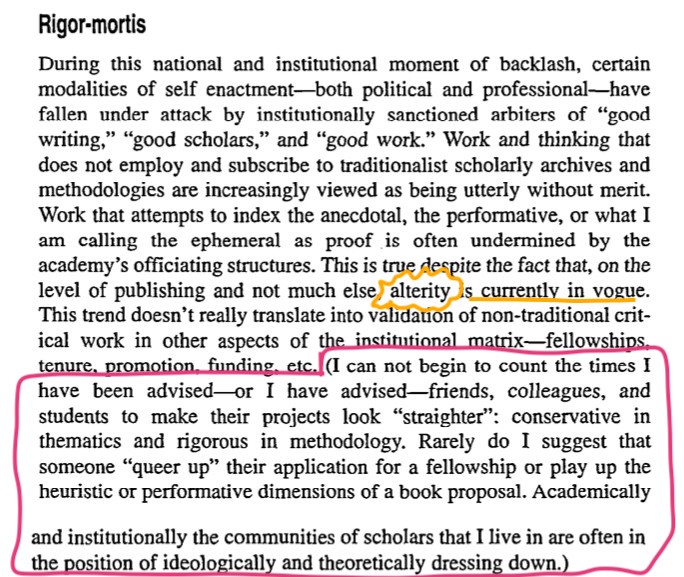
This week I was reading the above cited article by José Esteban Muñoz, when I was struck by the passage which I have excerpted and marked.

At the beginning of the coronavirus, I had this feeling that we were all in a stage play, wearing our costumes, holding our props, and speaking our lines from a well known script. All of a sudden that script, those words, vanished. And we were left holding ourselves in absurd postures, wearing costumes that did not fit us. At that initial moment of crisis, back in March, it felt strange, and often wrong, to be going through the motions. The starkness of crisis revealed the contours of intellectual structures and practices that we have irresistibly carried with us, but not consciously wished to do so. Cultures, traditions, structures of thought persist through repetitions, internalizations, citations; these are living and embodied practices. When the coronavirus revealed what it was we were actually doing — when the national uprisings in the fight for Black Lives underlined what we have been doing, what we are still doing — these were and are moments to reframe how we relate to ourselves and to each other. To return, then, to Muñoz’ words:

“This is true despite the fact that, on the level of publishing and not much else, alterity is currently in vogue… (I can not begin to count the times I have been advised—or I have advised—friends, colleagues, and students to make their projects look ‘straighter’: conservative in thematics and rigorous in methodology. Rarely do I suggest that someone ‘queer up’ their application for a fellowship or play up the heuristic or performative dimensions of a book proposal. Academically [p8] and institutionally the communities of scholars that I live in are often in the position of ideologically and theoretically dressing down.)”

In my field as much as any other, we are rooted in scholarly traditions and practices and proceed with these prior works as guides to our own thought, carrying these weights with us to load down and substantiate our own work. Yet, moments of rupture such as the ones we are currently experiencing reveal that there are other modes and practices which we desperately need. “Alterity” as a process seeks — not just “otherness”, and not just the “counter-cultural” — but, specifically, putting our eyes and our attention where it has not gone before. This means broadening our horizons, including texts and artefacts we haven’t considered before, citing the work of scholars outside of the gravitational pull of the citational traditions we currently have. But it also means examining our own interior commitments to structures which ultimately do not serve us.

Muñoz refers here to the process in which scholars and students learn to mute themselves, to form themselves into commodities based on the marketplace of scholarly desire which rewards presentations of comfortable sameness. Yet the image we’re supposed to be reflecting and performing is obsolete, artificial; the standards and shapes we replicate in our bodies and our thoughts are dependent upon eras in which we ourselves did not live, and which had values we no longer share. Muñoz wrote these words in 1996, but these processes are still happening around us and within us. Sara Ahmed wrote in Living a Feminist Life (2017: 4) about how feminist work must operate at the most interior level:

I began to realize what I already knew: that patriarchal reasoning goes all the way down, to the letter, to the bone. I had to find ways not to reproduce its grammar in what I said, in what I wrote; in what I did, in who I was.

We are living in rupture. Many things are shifting, opening, falling away. What stays and what goes? What inherited beliefs about scholarly and pedagogical practice — ideas and behaviours which never quite sat right with us in the first place — are we going to get rid of? What new words and new thoughts are we going to use?