As the new academic year approaches, I intend here to set some expectations for myself and others who work with me, or might wish to work with me. For the next year, thanks to a BUCH Junior Fellowship, I am on a research leave, which means I am not teaching and I am taking a step back from a number of things.
To be honest, being able to take a research leave like this would have been an immense privilege even under regular circumstances. But in the face of the coronavirus crisis, and how it is being handled across the country, it is a miracle. I know how lucky I am, and I don’t take any of this lightly.
Inspired, in part, by Adrienne Maree Brown’s recent discussion of what it means to take a sabbatical (part 1 | part 2), I am taking a conscious step back from some of the spaces which I regularly inhabit, including digital ones. In some cases, this will mean less visibility, in others more. After I finished a big project this summer, I unexpectedly found myself naturally disconnecting from twitter, which has always been a place of community and collaboration for me. At the same time, instagram has interestingly become a renewed site of creativity and communication. And as I reconsider my own relationship to writing in the wake of finishing the project to which many years of my life were devoted, I find myself wanting to write here on the blog more and more. In essence, I expect there to be a kind of hybridity to the presences and absences of my leave taking.
Living in the context of the pandemic has been a revelatory experience for me in many respects. As I wrote here a few days ago, the conditions created by the coronavirus have exposed for me the ways of thinking, doing, and being that do not serve me or the communities which I am a part of. It is with the mindful spirit of recalibration and renewal that I go into this next year. Yet while I may be less present, and at times less available, than I am accustomed to be, there are still a number of ongoing projects which I am involved with and will continue to give my care and attention to. At the same time, I will likely be less responsive to new requests, and I am thankful for your patience when that inevitably ends up being the case.
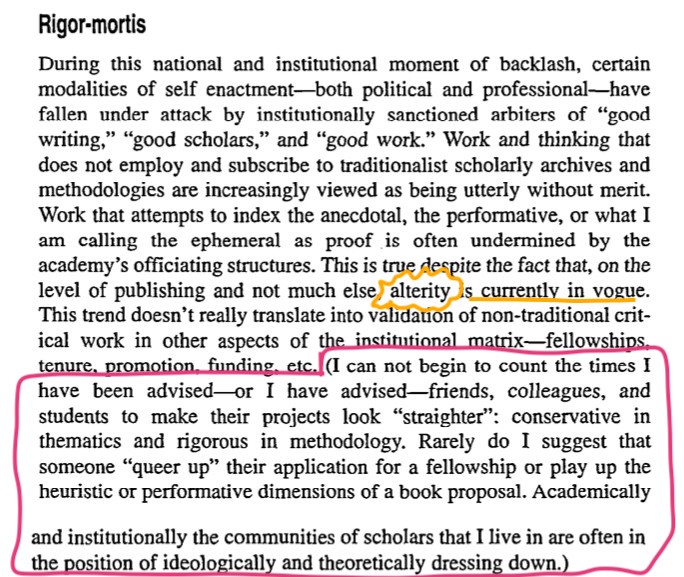
This week I was reading the above cited article by José Esteban Muñoz, when I was struck by the passage which I have excerpted and marked.
At the beginning of the coronavirus, I had this feeling that we were all in a stage play, wearing our costumes, holding our props, and speaking our lines from a well known script. All of a sudden that script, those words, vanished. And we were left holding ourselves in absurd postures, wearing costumes that did not fit us. At that initial moment of crisis, back in March, it felt strange, and often wrong, to be going through the motions. The starkness of crisis revealed the contours of intellectual structures and practices that we have irresistibly carried with us, but not consciously wished to do so. Cultures, traditions, structures of thought persist through repetitions, internalizations, citations; these are living and embodied practices. When the coronavirus revealed what it was we were actually doing — when the national uprisings in the fight for Black Lives underlined what we have been doing, what we are still doing — these were and are moments to reframe how we relate to ourselves and to each other. To return, then, to Muñoz’ words:
“This is true despite the fact that, on the level of publishing and not much else, alterity is currently in vogue… (I can not begin to count the times I have been advised—or I have advised—friends, colleagues, and students to make their projects look ‘straighter’: conservative in thematics and rigorous in methodology. Rarely do I suggest that someone ‘queer up’ their application for a fellowship or play up the heuristic or performative dimensions of a book proposal. Academically [p8] and institutionally the communities of scholars that I live in are often in the position of ideologically and theoretically dressing down.)”
In my field as much as any other, we are rooted in scholarly traditions and practices and proceed with these prior works as guides to our own thought, carrying these weights with us to load down and substantiate our own work. Yet, moments of rupture such as the ones we are currently experiencing reveal that there are other modes and practices which we desperately need. “Alterity” as a process seeks — not just “otherness”, and not just the “counter-cultural” — but, specifically, putting our eyes and our attention where it has not gone before. This means broadening our horizons, including texts and artefacts we haven’t considered before, citing the work of scholars outside of the gravitational pull of the citational traditions we currently have. But it also means examining our own interior commitments to structures which ultimately do not serve us.
Muñoz refers here to the process in which scholars and students learn to mute themselves, to form themselves into commodities based on the marketplace of scholarly desire which rewards presentations of comfortable sameness. Yet the image we’re supposed to be reflecting and performing is obsolete, artificial; the standards and shapes we replicate in our bodies and our thoughts are dependent upon eras in which we ourselves did not live, and which had values we no longer share. Muñoz wrote these words in 1996, but these processes are still happening around us and within us. Sara Ahmed wrote in Living a Feminist Life (2017: 4) about how feminist work must operate at the most interior level:
I began to realize what I already knew: that patriarchal reasoning goes all the way down, to the letter, to the bone. I had to find ways not to reproduce its grammar in what I said, in what I wrote; in what I did, in who I was.
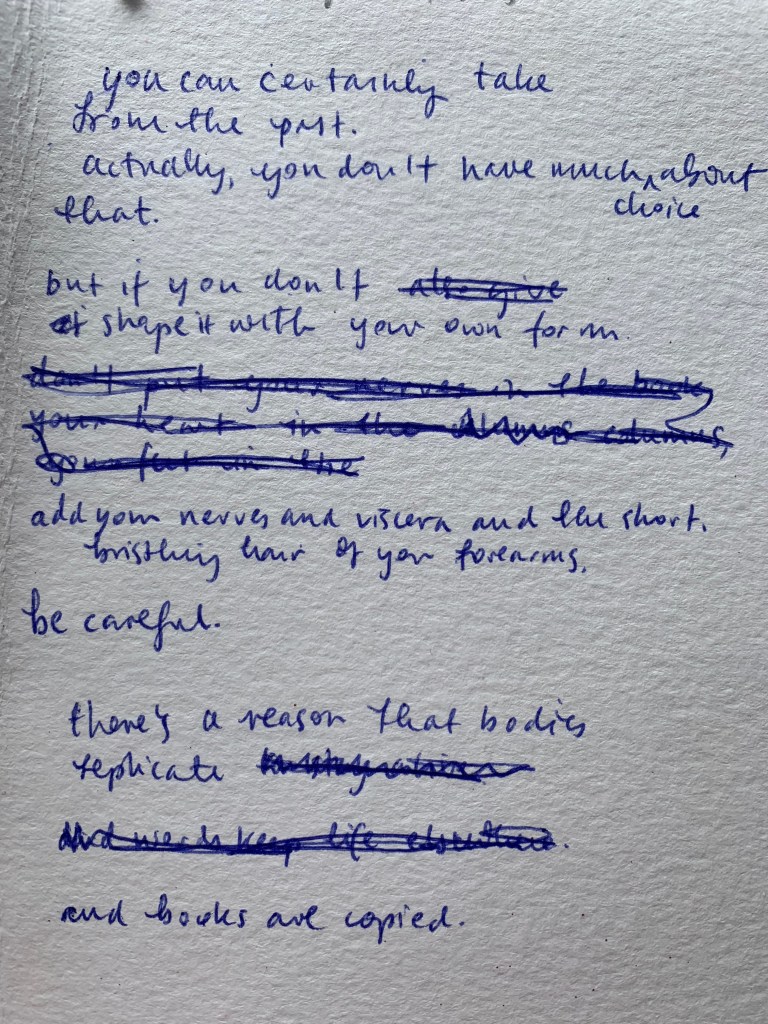
We are living in rupture. Many things are shifting, opening, falling away. What stays and what goes? What inherited beliefs about scholarly and pedagogical practice — ideas and behaviours which never quite sat right with us in the first place — are we going to get rid of? What new words and new thoughts are we going to use?
On 5th January 2020 I took part in a commemoration of Tom Habinek at the SCS organized by James Ker, Andrew Feldherr, and Enrica Sciarrino; with Basil Dufallo, Zsuzsanna Várhelyi, Scott Lepisto, and Enrica Sciarrino, and myself as panelists. With the generosity of Hector Reyes, we were able to read Tom’s (incomplete) book manuscript on the topic of personhood and authorship. Here’s the text of my contribution to the workshop, in case of interest. Enormous thanks to everyone involved and everyone who came to the panel.
It is my task today to speak on the concept of generativity as discussed in Tom’s manuscript. When I think of Tom’s work and the influence he had on students like me, it is, indeed, particularly his theorization of generativity which I feel to have been the most impactful. In earlier works, Tom’s interest in generativity manifested in his study of social generation via cultural production and reproduction, with a focus on how ritual acts instantiated Roman community. In a key passage of The World of Roman Song (2005, p129), Tom cited the work of the anthropologist, Paul Connerton, who, in How Societies Remember (1989, p62) discussed Thomas Mann’s understanding of the Freudian ego:
“We are to envisage the ego, less sharply defined and less exclusive than we commonly conceive of it, as being so to speak ‘open behind’: open to the resources of myth which are to be understood as existing for the individual not just as a grid of categories, but as a set of possibilities which can become subjective, which can be lived consciously. In this archaising attitude the life of the individual is consciously lived as a ‘sacred repetition’, as the explicit reanimation of prototypes.”
The “explicit reanimation of prototypes” is how Tom understood Roman self-construction: the invocation of ancient exemplars; the continuous citation and reinscription of Roman ancestral memory; rituals which resubstantiated the dead in the bodies of the living. Roman literary and political history demonstrates clearly that the Romans were interested in how their culture generated and regenerated itself; how the present day related to the past and preserved a tensile balance between new iterations of Roman youth, and their ancestral blueprints. All we need think of is the late Republican Brutus contemplating his ancestor, the expeller of kings; or perhaps Cicero in the Pro Caelio raising the ancient, blind Appius Claudius from the dead to speak with Cicero’s own lips and chastize Cicero’s own enemies.
In his latest work Tom approached the question of Roman generativity from some new perspectives. In his search for an understanding of Roman personhood, he figured the Roman persona as an active process, not a passive state; I think that for Tom persona was not a noun, but a verb. “Personifying” is a practice — it is an action, it is alive. Starting from this position, Tom was able to see different kinds of ancient evidence not as discrete, disconnected elements of Roman intellectual systems, but rather mutually supportive organs of an organic, synthetic whole. Tom’s work instantiates a theorization of human culture which does not merely render literature, or law, or art objects into cynical, insensate records of elites and auteurs. His organic approach reveals that the ancient artefact is an expression and mirror of biological as well as cultural forms. To put it another way, without really knowing that they are doing so, humans make things which reflect their insides. Tom’s work makes you realize that when you read a Latin text, that text is actively trying to constitute you into a Roman reader — like a 3D printer with instructions to produce a piece of plastic in a specific way, the scientific, ethical, political scripts of the Roman text tries to makeus.
With this, or something like this, in his mind, Tom in this latest work proceeded to examine generativity in a number of different types of ancient evidence, ranging from the practices of Roman bride dowries to the emergence of birthday celebration as a theme in Latin love elegy. Underneath each artefact, Tom found a consistent preoccupation in the Roman attitude to cultural and biological reproduction which expressed a profound anxiety, one which can be conveyed in the form of a simple question. Will we continue to survive?
Romans expressing this anxiety in different ways figured reproduction, with its insistence upon a continuity of resources, as relating to survival in the long term. The fact that Roman bride dowries are reabsorbed into the natal family to allow women to marry again and to have children is, Tom suggests, an intentional defense mechanism against the failure to reproduce. As a result, generativity in Roman thought relates not only to explicit, biological reproduction (i.e. producing children), but making provision for a self-sustaining reabsorption of assets as part of a framework which allows such reproduction to take place. At its core, this legal provision expresses a care to conserve not just culture or biology but energy; like keeping a little something left in the storeroom in case of an unexpected hunger. Cast in this light, Roman conservatism, which is so frustratingly obvious and, frankly, obtusesometimes (just think of Cato the Elder) seems to be not simply fanatical traditionalism, but indeed a form of conservationism.
It is an impulse to conserve that Tom saw in the Roman discourse around luxuria. The chastizing of luxuria is not simply, Tom suggests, a knee-jerk political reaction against perceived excesses and hedonism, but rather a criticism of “pointless growth” — i.e. the expenditure of energy which will not return, will not be reabsorbed and thereby conserved for future use. Tom notes that criticism of luxuria in Roman texts so often employ agricultural and botanical metaphors because luxuria was an metaphysical outgrowth which defied the boundaries of the carefully proportioned Catonian fields, designed and tended to produce year after year. Incidentally, Tom made a point to note that luxuriant excess — a squandering of resources, the refusal to regenerate, to conserve, to recycle — expressed itself in many different ways: the fact that furniture, fine art, construction, urban development, and non-reproductive sex were each as bad as each other speaks to the intersection of conservatism with conservationism in the Roman attitude; i.e. having fancy pedestal tables and sideboards (Livy 39.6) is just as bad as fucking your boyfriend because you should, good Roman, be conserving your attention and energies for generative activities. Here, Tom seems to have revealed a kind of biological essentialism in Roman thought which is not usually, I think, made explicit. Tom notes that while the elegists and other figures from the Roman counter-culture were “ambivalent” about such a formulation of luxuria, they nonetheless accepted its definition; that is, while they did not play by these rules, they accepted that these indeed were the rules. Even if you are walking away from Rome rather than towards it, you are still on the road to Rome.*
Tom translates the Latin luxuria as “pointless growth”, “withering growth”, “wild growth.” An agricultural, biological symptom of “bad” growth is itself a helpful tool to reveal the nature of “good” growth, and Tom realized that, in Roman thought, “good” growth often related to an inseparable dualism: life and death. An insistence that growth (that is “good” growth, not luxuria) is actually related to death appears, Tom says, in the Pro Marcello (23): Cicero’s exhortation of Caesar to propagate new growth includes the impossible wish that Caesar could bring the dead back to life, if only that were possible. Indeed, the relationship between the living and the dead at Rome was one of Tom’s deepest preoccupations; in the book proposal for the project, Tom had focused in on a passage from Rudolph Sohm which I believe was, for him, programmatic: “the heir is treated as though he were deceased…the deceased continues to live in the person of the heir” (1907, p504). Indeed, the idea that the dead live in the face, the name, and the actions of the living is one of the vital aspects of Roman generation, regeneration, generativity. Tom’s discussion of generativity in this manuscript reveals a living organism, a beating heart underneath the details of textuality. According to his understanding, the Romans formulated their generative function as a life pulse which conserved itself, returned to itself, and, being limited, precious, did not waste itself.
*Ursula Le Guin, The Left Hand of Darkness (1969/1999, p151): “To oppose something is to maintain it. They say here ‘all roads lead to Mishnory.’ To be sure, if you turn your back on Mishnory and walk away from it, you are still on the Mishnory road.'”
Student Commentaries (#CL351) on Cicero De Natura Deorum or De Divinatione
You must include the following elements:
Choose a passage of at least 350 words; you may copy + paste the text from thelatinlibrary.com, but note that there may be textual differences, so make sure to check against the text
Write an introduction to the passage that contains information about the author’s life and work, the genre of the selection, and an overview or outline of the work from which the passage is taken
Write a reflection, based on research (use bibliography on syllabus), about the broader significance of the content of the passage, and how it relates to the rest of the work
Write a translation of the Latin passage in your own words
Give a bibliography of print and internet sources consulted
[optional: A print-out of images that illustrate the text, with references]
Comments to the text arising from student reading, such as:
complete dictionary entries for less-common words with the recommended translation for the word, as it is used in the immediate context, placed first, followed by a range of possible meanings
explication of grammatical forms, syntax, word order, rhetorical devices
identification of people, places, events, references
interpretation of ideas in the text and meaning that is not readily apparent
Students of the current CL 351 produced the following (partial) commentary with me on ND 1.3ff., Tuesday 12th October. Asterisks denote passages which will need to be filled in by further reference and research. What is nice about this, the product of a very short workshop, is how many ideas can be generated from even a little piece of text. And the asterisks are an index of initial thoughts which can be developed with further investigation.
Classroom test case: De Natura Deorum 1.3-7
[3] Sunt enim philosophi et fuerunt, qui omnino nullam habere censerent rerum humanarum procurationem deos. Quorum si vera sententia est, quae potest esse pietas, quae sanctitas, quae religio? Haec enim omnia pure atque caste tribuenda deorum numini ita sunt, si animadvertuntur ab iis et si est aliquid a deis inmortalibus hominum generi tributum; sin autem dei neque possunt nos iuvare nec volunt nec omnino curant nec, quid agamus, animadvertunt nec est, quod ab is ad hominum vitam permanare possit, quid est, quod ullos deis inmortalibus cultus, honores, preces adhibeamus? In specie autem fictae simulationis sicut reliquae virtutes item pietas inesse non potest; cum qua simul sanctitatem et religionem tolli necesse est, quibus sublatis perturbatio vitae sequitur et magna confusio; [4] atque haut scio, an pietate adversus deos sublata fides etiam et societas generis humani et una excellentissuma virtus iustitia tollatur. Sunt autem alii philosophi, et hi quidem magni atque nobiles, qui deorum mente atque ratione omnem mundum administrari et regi censeant, neque vero id solum, sed etiam ab isdem hominum vitae consuli et provideri; nam et fruges et reliqua, quae terra pariat, et tempestates ac temporum varietates caelique mutationes, quibus omnia, quae terra gignat, maturata pubescant, a dis inmortalibus tribui generi humano putant, multaque, quae dicentur, in his libris colligunt, quae talia sunt, ut ea ipsa dei inmortales ad usum hominum fabricati paene videantur. Contra quos Carneades ita multa disseruit, ut excitaret homines non socordes ad veri investigandi cupiditatem. [5] Res enim nulla est, de qua tantopere non solum indocti, sed etiam docti dissentiant; quorum opiniones cum tam variae sint tamque inter se dissidentes, alterum fieri profecto potest, ut earum nulla, alterum certe non potest, ut plus una vera sit. Qua quidem in causa et benivolos obiurgatores placare et invidos vituperatores confutare possumus, ut alteros reprehendisse paeniteat, alteri didicisse se gaudeant; nam qui admonent amice, docendi sunt, qui inimice insectantur, repellendi. [6] Multum autem fluxisse video de libris nostris, quos compluris brevi tempore edidimus, variumque sermonem partim admirantium, unde hoc philosophandi nobis subito studium extitisset, partim, quid quaque de re certi haberemus, scire cupientium; multis etiam sensi mirabile videri eam nobis potissimum probatam esse philosophiam, quae lucem eriperet et quasi noctem quandam rebus offunderet, desertaeque disciplinae et iam pridem relictae patrocinium necopinatum a nobis esse susceptum.
Commentaries: — Pease commentary [available online thro’ Haithi]; this is at the more dense end of the spectrum — Dyck commentary [Mugar: PA6296 .D4 2003] — P. G. Walsh commentary [Mugar: PA6308.D4 W35 1997]
Databases: — phi latin corpus < use this to find how other authors use words or phrases — Brill New Pauly < use this to look up unknown names — Logeion < use this to look up words in Lewis & Short — Allen & Greenough online < use this to look up and reference grammar/syntax — jstor.org < use this to look up scholarly articles
Additional resources. Enormous thanks to Dr. Katrina Dickson for sending these along!
University of Illinois Library Guide created for a Latin Commentary Assignment
As part of our recent event at the University of Southern California, sponsored by the USC Classics department, the Levan Institute, and the USC Society of Fellows, I gave a short presentation on the ethical value of scholars being part of the project of the internet, using the tools of social media. See below a link to the slides from my presentation. We’ll be posting a piece on the Classics and Social Justice blog soon with a summary and reflection of the two day event.
On April 6th 2017, the University of Southern California’s Center for Excellence in Teaching held an event entitled “Pedagogy of the Empowered”. Four Teaching Assistant Fellows — Leslie Bernsten, Mary Donhoffner, Rima Basu, and Lizette Solórzano — spoke individually about how to be inclusive in classroom dialogues on political or difficult topics, providing us with strategies and practical advice on how to deal sensitively with specific scenarios that can and do happen. This is exactly the kind of event that is essential in the current political climate, and I left the session feeling that everyone who is teaching right now should attend an event like this at least once. I was grateful to be able to attend.
Leslie Bernsten opened the session by saying that teaching is a caring profession; research supports that the best teaching is that which is above and beyond the call of duty. She mentioned the anxiety that some may have of being a teacher at an R1 university, where you might not be expected to make teaching a priority, and perhaps will receive less support from the institutional framework around you. But she affirmed something that I have always felt — that the best teaching happens when human beings treat others as human beings. Here are some tools and strategies which I took away from this event:
If you want to respond to a recent political moment in the classroom, be clear with yourself and your students on why you are doing so. The classroom is not the right place to rant about how you feel about what’s going on in politics. If you want to talk about something that is happening, make sure you tie it in to part of the curriculum, and take the time to present it in a way that does not simply reflect your own political beliefs, but allows students — who have many different beliefs and experiences — to be able to engage with it.
Prepare, prepare, prepare. If you want to talk about a politically charged issue, prepare as much as you can in advance.
Create a classroom contract. How do you set up your classroom so that serious conflicts do not occur? How can you make sure that everyone feels fairly treated, and that the class discussion is productive for everyone? One way to prepare is to be clear from the first day what your students can expect from you, and what you expect from them. Guide them through the syllabus to show your expectations. How will late work be dealt with? How will grading work? How will conflict in the classroom be handled? An effective strategy is to have the students workshop community guidelines: have your students work together to write a charter which describes how they will behave towards each other. And always explain to your students why you’re having them complete a task; doing this can help avoid a sense of being infantilized.
Be aware of how you can help marginalized students. Many students have had experiences which leave them emotionally and legally vulnerable. Recent studies show that at certain universities up to 30% of female students are survivors of sexual violence. That means that you need to keep in mind that there is a very high probability that several of your students (male and female) have had this experience. If a student confides in you that they have been sexually assaulted, you are legally obligated to report this to the Title IX officer at your university. Many of your students may also be undocumented, or their family members may be undocumented. These students are living with a very real threat of deportation. If a student confides in you that they are undocumented, you must not tell this to anyone else. This is an example in which maintaining confidentiality is crucial. Teachers at the university level are not necessarily (and perhaps even usually) trained to be able to give students the support which they need; instead, we have to know where to send them when they need help. So we should know what the counseling services are, and whether our university has an immigration clinic. In these cases, we must send our students to trained professionals who can help them emotionally and legally.
The panel discussed the fact that sexist behaviours against women often come in insidious, undetected forms. Sexism happens casually, unconsciously — sexist ideas are so ingrained in our culture that they feel natural, but such gender coding has long-term effects for women, their treatment by both men and women, and their opportunities for leadership.
The AAUW panel discussed some of the implications of institutional sexism, and offered some solutions. The term “microaggression” was first used by psychiatrist Chester Pierce in the 1970s in the context of racial discrimination in commercial advertising, but has been expanded greatly by psychologists in recent years. Gina Torino was one of the co-authors of a highly influential academic paper, “Racial Microaggressions in Everyday Life”, which defines microaggressions as “brief and commonplace daily verbal, behavioural, or environmental indignities, whether intentional or unintentional, that communicate hostile, derogatory, or negative racial slights and insults towards people of colour“ (2007:271). The fact that the term originated in the study of racism and has been expanded to include sexist and classist behaviours alongside racist ones demonstrates that intersectionality is at work here.
The panelists shared their experiences of microaggressions: a male co-worker only says good morning to his male colleagues; a woman of colour is asked where the professor is when she’s the professor; another professor makes digs against women in an engineering class that is 20% women. In each case, the implicit message is: you don’t belong here, your body signals you as different from what I want or expect. Even if the person (man or woman) responsible for sending the message has no idea they are doing so. The panelists cited studies in which respondents, asked whether sexism still existed, answered “no” but still blamed women for not being more proactive in their achievements. The problem is that sexist behaviour is so prevalent that it becomes invisible. This means that women keep being silenced and excluded, and then they are blamed for their apparent incompetence. And women also blame themselves when they are at the receiving end of sexist behaviour.
The panelists also discussed strategies for communicating the problem of sexism to an audience that is inclined to deny its existence. They said that studies have shown that male listeners are likely to “circle the wagon” when confronted with reports of sexism; they double down on the status quo. The panelists suggest making changes by seeking support: find female colleagues who can validate your experiences; communicate your experiences through storytelling to male and female audiences. What doesn’t seem to work is an explicit statement of the problem — this seems generally to provoke an impulse to deny. If there is any way forward it is through persistence and through empathy — shining more light on the stories of sexism, and communicating these personally.
The AAUW also has an excellent discussion guide, which lays out how to engage in productive discussion about sexism in a formal setting. What I especially like about this guide is its care to bring muted voices into the forefront in the “community agreement”, which in many ways reminded me of WCC’s practical tips for feminist pedagogy:
What’s shared here stays here, but what’s learned here leaves here. The group agrees to confidentiality of names, but the knowledge and insight garnered will stay with them once they leave the room.
One speaker, one mic. When someone is speaking, they should not be interrupted. Everyone who would like to speak will be given the opportunity.
Move forward, move back. If you normally are the first to contribute to the conversation, considering allowing others the chance to speak. If you normally are shy, challenge yourself to share your opinions.
Challenge by choice. While everyone is encouraged to leave their comfort zones and share their thoughts, no one will be forced to share.
Listen to understand, not to respond. When others are talking, make sure you’re digesting everything they’re saying, rather than simply waiting for your turn to speak again.
In many ways, I’m not a digital humanist. I don’t know how to code. I’ve never built a database. I don’t work with “data”. My research would be quite challenging to communicate visually (with charts, infographics) in a way that would be satisfying. I have a basic literacy in html which is pretty much obsolete now. A lot has been written about the fact that “digital humanities” is difficult to define, exactly. When I was at Patrick Burns’ Ancient MakerSpaces digital classics workshop at the 2017 SCS — which showcased tools for creating and managing digital information within the field of Classics — it occurred to me that I had a different background than the majority of the other audience members. Many of the individuals in the audience had a similar level of technological literacy to the speakers — they could understand the presentations from a technical perspective in a way that I simply couldn’t. But I think it’s important for people like me — perhaps more “humanist” than “digital” — to be present in such spaces. These are the ways in which I do consider myself a digital humanist: I am present in a scholarly persona online, and I believe that scholars should be engaged in the project of the internet. I’m a digital humanist in the sense that I want to tell the stories of the humanities online, using its tools to reach a larger audience, and to increase the reach of learned networks beyond its traditional limits. And I see the benefits of bringing the forms of the internet, which encourage discussion, into the classroom (with blogging etc.).And someone like me can perhaps help make bridges between the digital and non-digital humanists. Even if you yourself as a scholar are not engaged in a particular aspect or practice developing within your field — such as digital humanities — you’re still influenced by these developments. Weller (2011: loc 2612) calls this “network weather”, i.e. “changes in your environment are occurring because of other people’s use of these technologies and the behaviour they facilitate, even if as an individual you are not engaged with them.”The digital humanities — which gives us online editions and commentaries of texts, databases of papyri, digital books, thousands of high quality images of ancient objects facilitated by creative commons license, and more — are already pretty incredible, and are only going to get better and better, provided they find continued support, financial and otherwise. It’s up to us to shine a light on these projects and tools, and to make sure our students — especially the graduate students who will shape the next generation of Classics — are given the opportunities to learn and use these tools.
We’ve been speaking a lot about Classics outreach lately. And most agree that “outreach” – in the sense of a one-sided “reaching out” – is not quite the right term anymore. Alison Innes (@InnesAlison) recently argued for the term “engagement” rather than “outreach”, since engagement suggests a notion of exchange rather than the flow of knowledge in only one direction. The preference for engagement over outreach has been visible for a while — this was the takeaway from the “New Outreach and Communications for Classics” panel at the 2017 SCS, where speakers described community projects: teaching Latin to kindergarteners, high schoolers; working through Homer with combat veterans; connecting classicists outside of academia. The notion of outreach as engagement and collaboration is also at the core of the new Classics and Social Justice group, which wants to bring Classics to the least privileged in society. There have been some questions lately about whether or not twitter can be a useful tool for Classics engagement — in this debate, I stand firmly on the side that sees the value in twitter. There is much more to “outreach” than can be accomplished by social media alone, but it’s still a valuable place to start.
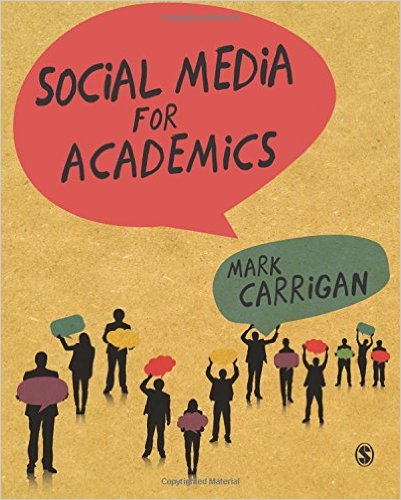
I use twitter in my scholarly persona — I tweet about my research, I live tweet conferences, I interact with other academics and non-academics interested in Classics, I find news about my discipline on twitter. If I were teaching right now (I have a research fellowship), I would be using it in the classroom. But I wanted to learn more about academic twitter from a scholarly perspective – to learn how it’s studied as a social phenomenon by academics. For this, I turned to sociologist Mark Carrigan’s (@mark_carrigan) book which came out last year, Social Media for Academics.
Mark Carrigan, Social Media for Academics. Sage; Los Angeles. 2016. ISBN: 9781446298688
Although Carrigan’s book contains many helpful tips for academic blogging and tweeting, it’s not primarily a how-to guide but rather a sociological exploration of the state of academic tweeting as it exists today. As Carrigan writes (loc 166)¹, social media develop so quickly that by the time a scholarly work is finally published, the information it contains is already outdated. The first chapter begins by describing the almost unimaginable volume of information which is published on the internet every day, citing the Internet Live Stats project. If you click on this link, you can have the frankly nauseating experience of seeing how many blogs, tweets, emails, skype calls, tumblr posts are being made/sent in real time. But it’s a powerful way to show the vastness of the internet, its modes, and its growth. Sometimes social media are maligned as essentially superficial — but something more complicated, with greater consequences, is going on. Social media touch our personal lives, our political lives, and the state of our knowledge. Recently, I tweeted about how the current POTUS’ use of twitter will force future historians to come to terms with the nature of social media and its impact on society and knowledge — a compelling reason why scholars should now be involved in the project of the internet.
One of the best things that I got out of this book is that the notion of “scholarship” doesn’t have to be defined by the memory of past models, but by the actions which we now take. Carrigan — citing Weller (2011: loc 105)— writes that “scholarship is what scholars do.” The tautology of this definition is actually helpful – it can free us from saying “this action isn’t scholarly”, and allow us to say “well this scholar is doing this, therefore by definition it is included in the remit of what scholarship is.” Being freer about the definition of what is or isn’t scholarly can allow scholars to embrace parts of themselves that they feel they have to hide to live up to the image of academia. I’ve written elsewhere about how it’s no coincidence that those who are attracted to scholarly twitter are those from groups typically underrepresented by the “professor” archetype (PoC, women, LGBTQ+) — twitter is a new(er) space where the performative associations of the “professor” don’t have to be enforced. In fact, Carrigan notes that, if you are an established or even famous scholar, you can’t assume that that is enough to attract followers or to foster a positive reception of your social media presence (loc 2239). This is because social media is about prolonged, consistent engagement. It’s about what you’re saying in the moment, and it’s as much about listening as it is about broadcasting.
What becomes clear over the course of Carrigan’s book is that the main activities of scholarship — writing, publishing, networking, engaging — are all involved (and, arguably, enhanced) when scholars use social media. The only difference is that, when we use social media, the actions that are essential to the life of the scholar are taken in public.
For Carrigan (citing dana boyd 2014), social media have specific and significant qualities which bring scholarship into the public eye — persistence, visibility, spreadability, searchability:
persistence: once ideas are posted they (theoretically) last forever— “the experience of twitter is similar to that of being at an academic conference, but a conference in which our conversations linger on indefinitely in the room” (Carrigan loc 276); in this sense, social media is a form of record keeping
visibility: ideas once posted can be seen by many people — with a platform like twitter, you don’t even have to have an account to see what’s happening on it; using social media brings your scholarly work into the view of the public, to whom you may otherwise be invisible — and it can also make your work more visible to other scholars
spreadability: ideas once posted are easily circulated — sharing or retweeting brings information into the sight of your friends or followers, who can then pass it on to their friends or followers
searchability: ideas once posted can be found with search terms— and since they are persistent and visible, i.e. are lasting and accessible to everyone, ideas can be found even if they haven’t been widely circulated
Carrigan is sensitive to the issue that “public” is a complicated idea; he opts instead to call the online audience “publics” (loc 1174). When scholars use social media to publicize their own work, and also — by extension — the kind of work done by their discipline, who are they talking to? Although Carrigan mentions the usefulness of social media in teaching students, this is not his main focus — he redirects his reader to Megan Poore’s guide, Using Social Media in the Classroom(2016). Instead, the interactions which he seems to focus on are between scholars and other scholars; between scholars and non-scholars. It isn’t exactly the case, Carrigan says, that when we use social media we are really trying to talk to “everyone” (loc 1149) — instead, we’re engaging in a kind of narrowcasting, defined by Poe (2012) as “the transmission of specific information to specific interest groups.” Narrowcasting may seem to support the view that twitter is an echo chamber, but Carrigan argues that the scale of the dissemination of information via the internet is much larger than anything we’ve known before (loc 1159):
This is a potentially transformative environment for academic research because it means that intense specialisation need not lead to cultural marginality. Even the most seemingly obscure topics have a potential audience outside the academy.
There is an assumption that because academic interests can be very specific, there isn’t an audience for that level of fine grained detail. Well, that’s not the case. Talking about a topic to people who are interested is powerful — it may not be that many people in the grand scheme of things, but it’s still many more than would have access to you, if that access was predicated on entry into a university environment.
And when academics use social media — even in a “professional” persona — we’re bound to include elements of our lives beyond just our work. Carrigan suggests that this can create a “new collegiality” between scholars (loc 894), because it draws attention to the obstacles faced by individuals which otherwise might not be spoken about. From personal experience, I find this to be true — I think of Ellie Mackin’s (@EllieMackin) open discussion of the challenges facing early career academics and the challenges of maintaining mental health in academia, which have found vigorous support in the online community.
Carrigan also points out the potential for social media to present a fuller picture of a scholar when “all manner of ephemera…get aggregated together into a stream, mean[ing] you sometimes get better acquainted with someone through a process that is almost osmotic” (loc 936). The aggregate view of the scholar is something that I love about twitter. At some point or another, you may read my CV, or some personal statement, or a research proposal. And certainly, we have to work hard rhetorically in such documents to make ourselves understood, to seem vibrant, to demonstrate our value. But you’ll really get to know me as a scholar if you follow me on twitter; you’ll get a sense, after the accumulation of hundreds of pieces of tiny information, of who I am – what my values are, how I do my research, how I interact with my community. You’ll also get a sense of who I am as a human person.
Blogging is also a large preoccupation of Carrigan’s book. One of the issues with scholarly blogging, which doesn’t seem to be explicitly stated by Carrigan but is definitely on my mind a lot, is the fact that we as scholars work hard to produce research that we can’t really give away for free. Our success depends on publication in traditional media — we get promoted because we write articles and books. One model suggested by Carrigan which gets around this problem, is that scholars can “blog about the work, but not blog the work” (loc 735). Academics can write about the process of writing, as well as sharing resources which have been encountered during the research. Carrigan brings up the issue of speaking to multiple audiences simultaneously, and how various prominent bloggers deal with this. He cites Paul Krugman, Nobel prize winning economist who blogs for the NY times, who labels the more technical posts as ‘wonkish’ in the title to signal potential difficulty for mass readership. And then, there’s our Mary Beard, who writes short blogs for the TLS every few days. Both of these figures are world class academics who are secure in their renown and reputation; and they have the confidence to be able to write short pieces frequently. They also have the confidence to be contemplative rather than positivistic — they can say “I’m thinking about this right now” rather than “this is definitively the case”. But that confidence comes from being established. Sensible equivocation in them may read as uncertainty and luke-warmedness in individuals of lesser status. But I do think that the model of writing short blog posts reasonably frequently is a good one — one that I’m thinking of using in the future myself.
Carrigan also draws attention to the usefulness of social media as research tools. This is definitely something that I’ve found to be true — twitter, for example, can have an archival function:
@opietasanimi Not to mention a placeholder for future leads that I don't have time for at the moment.
I frequently use tweetdeck to search for tweets I’ve made in the past about certain elements of my work. Blogging can have this function as well — working out some thoughts about a minor point and posting it online can serve as a organic growth of work, linked thematically rather than in a linear way — “the result is a ‘body of knowledge’ that is ‘more threaded and less sequential’ ” (loc 1558). Carrigan invokes Stuart Elden, writer of the Progressive Geographies blog, and his view that a blog is a “public notebook” or a “public set of bookmarks” (loc 1564). Live tweeting conferences also feels a bit like making notes in public.
In such a world where information is gathered (or aggregated) online, distraction is an issue. Anti social media screeds written by academics often begin from this point — that social media are a distraction. From what? Supposedly from the serious thinking and writing that happens when everything else is shut off. But for Carrigan, distraction is recoded as a positive thing, in the sense that, reading through the information that twitter and other outlets provide you ‘supersaturates’ (Gitlin 2002) the scholar with many relevant paths that could be followed. The problem, for Carrigan, is not that the distraction will lead you away from substantial to insubstantial thought, but that the distraction will lead you down many potentially fruitful alleyways which are different, if parallel, to the initial frame of inquiry. And Carrigan notes that this isn’t exactly — or at least necessarily — a bad thing. The issue is one which is actually very familiar to researchers — “The more we read, the more ideas we’re confronted with about what we haven’t read but should” (Carrigan loc 1509).
A related point here (not brought up by Carrigan) is that keeping up with social media now means keeping up with the social, in a way that is more conscious than it once was. Classics has been in crisis over its relatability for the entire time that I have been a classicist. But increasingly there are classicists who are interested in speaking to an audience beyond just the one which has typically been granted access to a classical education — and for these scholars, “outreach” is an ethical issue. There are groups of people, underrepresented and/or maligned in the past, which are now becoming more visible than ever. And one of the ways in which these groups have become more visible, is due to the power of representation which social media give them. When scholars engage online – even if their research has nothing to do with social issues – they can be witnesses to the kinds of problems which their students and their colleagues face that don’t necessarily occur to them from just their own experience.
All in all, Carrigan’s Social Media for Academics is a very good book. It deals sensitively and sophisticatedly with a number of issues facing academics who want to engage with social media, providing several models and examples. Recommended for anyone who wants to learn more about the sociology of social media.
Note 1: I read Carrigan’s book in its Kindle edition. Throughout this blog post, I use Kindle location numbers rather than page numbers. This is also how Carrigan, for the most part, makes his citations from other sociological works.



 o pietas animi